.png)
Care Doesn’t Stop at 5pm. Neither Should Your Help Desk

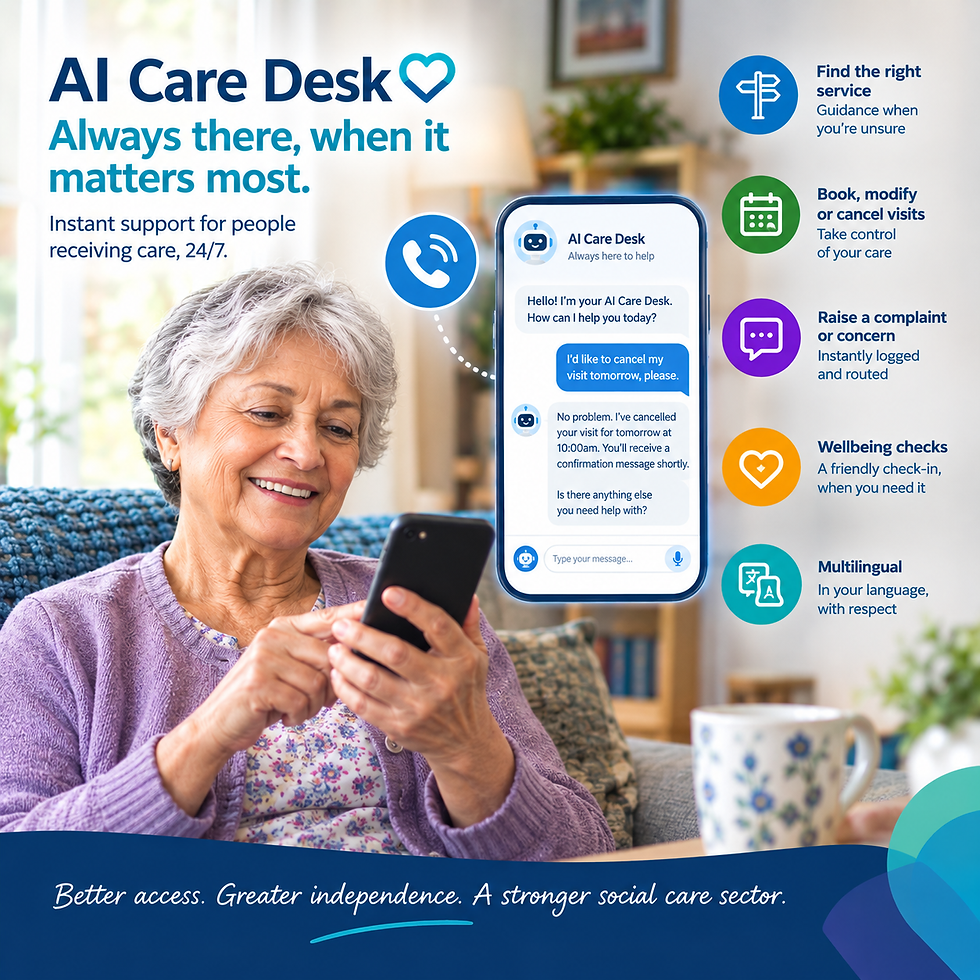
How an AI Care Desk can transform the service user experience
Here is a problem that most people outside the sector don’t think about.
A care service user develops a concern at 9pm on a Sunday evening. Perhaps they are anxious about who is coming to support them tomorrow. Perhaps they want to cancel a visit and don’t know how. Perhaps they have a complaint they need to raise, or they simply don’t know which service to contact for the help they need.
What are their options?
In most cases today, there are very few. They might try calling a number that goes to voicemail. They might leave it until Monday morning — by which point anxiety has built, the visit time has passed, or the concern has gone unrecorded. Or a family member steps in as an informal intermediary, absorbing a burden that should not fall to them.
This is a gap in social care that we have largely normalised. And it is one that AI is now well-placed to close.
The case for an AI Care Desk in social care
An AI Care Desk is not a chatbot that gives generic responses from a FAQ page. Implemented well, it is a genuinely intelligent, always-available point of contact — capable of understanding what a service user needs, responding in their preferred language, and either resolving the query directly or routing it to the right person with full context.
For UK social care specifically, the case is compelling. The sector serves some of the most vulnerable people in society, many of whom have complex, overlapping needs and little capacity to navigate bureaucratic processes. It operates through providers large and small, across commissioning structures that vary significantly between local authorities. And it is chronically under-resourced — leaving care coordinators and managers fielding routine enquiries that consume time they don’t have.
An AI Care Desk addresses all of this simultaneously.
What it can actually do
Signposting to the right service
One of the most common reasons someone contacts a care service is because they don’t know which service they need. The landscape of adult social care — home care, supported living, reablement, mental health support, community services, carer support, advocacy — is genuinely confusing, even for professionals working within it.
An AI Care Desk can guide someone through this landscape in plain, accessible language. It can assess what they are describing, identify the most relevant service or pathway, and direct them accordingly — whether that means connecting them to their care provider, their local authority, the NHS, or a voluntary sector organisation. Available at any hour, without the wait.
Beyond signposting, the AI can actively assist with form filling. Navigating care-related paperwork — whether that is a Continuing Healthcare checklist, a Personal Budget request, a Blue Badge application, or a referral form for an advocacy service — is a significant barrier for many service users and their families. An AI Care Desk can walk someone through a form step by step, in plain language, answering questions as they go, pre-populating fields where information is already known, and flagging anything that needs professional input before submission. For people who struggle with literacy, digital confidence, or cognitive complexity, this kind of guided assistance can be the difference between accessing the right support and giving up entirely.
Booking, modifying and cancelling visits
Service users should not have to wait until a coordinator is at their desk to manage their own care schedule. An AI Care Desk can handle these requests directly — checking availability, confirming changes in real time, notifying the relevant care workers and updating the schedule automatically.
This is particularly significant for people with early-stage dementia or cognitive difficulties, who benefit from being able to interact through a calm, consistent, conversational interface rather than navigating phone trees or waiting on hold. Giving people genuine control over their care arrangements is not just operationally efficient. It is a dignity issue.
Recording complaints and concerns
When something goes wrong in care, or when a service user simply has a concern they want to raise, the quality and timeliness of the initial response sets the tone for everything that follows. A concern raised at 8pm that goes unacknowledged until 9am the following morning is a concern that festers.
An AI Care Desk captures concerns the moment they arise, acknowledges them immediately, creates a formal, time-stamped record and routes them to the appropriate team for follow-up. Nothing falls through the gap. Every complaint is logged, traceable and included in the compliance picture — which matters enormously in a sector where CQC inspection can turn on the quality of complaint handling processes.
At DOM Portal, we have already implemented exactly this. Our customers can call our dedicated support line number 0333 7722 836 - 24 hours a day, seven days a week. An AI handles the call directly — gathering the details of the concern or complaint through a natural conversation, confirming what has been captured, and passing a complete, structured record to our human support team for follow-up. No voicemail. No waiting until Monday. No concern lost because it was raised at an inconvenient hour. The technology is not theoretical — it is live, and it is working.
Automated wellbeing checks and daily reminders
For service users who live alone or have limited social contact, a proactive AI wellbeing check — a simple, friendly message asking how someone is and whether they need anything — can be a meaningful touchpoint in the hours between care visits.
If a person doesn’t respond, responds in a way that suggests distress, or raises a concern, the system escalates automatically to a care coordinator or emergency contact. The check becomes part of the care record. And the assurance that someone — even an AI — is checking in regularly can provide genuine comfort to isolated individuals and the families who worry about them.
Alongside wellbeing checks, an AI Care Desk can provide personalised daily reminders that support independence and safety. For service users managing their health at home, the gap between care visits can be a vulnerable time. Timely, conversational reminders — delivered through the person’s preferred channel, whether that is a phone call, a message, or a smart speaker — can make a real difference to outcomes.
In practice this means:
● Medication reminders — prompting the person to take their medication at the right time, and logging whether they have confirmed they’ve done so. Where a response is missed or a concern raised, the system alerts the care team.
● GP and appointment reminders — notifying the person the day before and on the morning of any healthcare appointment, with the location, time, and any preparation needed. For people with memory difficulties, this kind of structured reminder significantly reduces missed appointments.
● Daily routine prompts — gentle nudges to eat, drink, or complete a personal care task, tailored to the individual’s care plan and preferences.
● Carer arrival notifications — a heads-up that a care worker is on their way, reducing anxiety for people who find unannounced visits distressing.
None of this replaces care. But in the hours when no professional is present, it extends a thread of support that can be genuinely reassuring — for the person receiving care and for the family members who cannot always be there.
Multilingual by design
This is where AI can do something that no traditional help desk arrangement can replicate at scale.
The communities that rely most on social care in the UK are among the most linguistically diverse. There are older residents whose first language is Punjabi, Urdu, Bengali, Polish, Somali, Cantonese, or any one of dozens of others. There are family carers who struggle to communicate effectively on behalf of their relative because the system only operates in English. And there are care workers from diverse linguistic backgrounds who would benefit from support in their own language.
An AI Care Desk can communicate fluently across multiple languages — not through a clunky, visible translation layer, but through natural conversation in the user’s preferred language. For a local authority commissioning care services in a borough with significant linguistic diversity, this isn’t a feature. It is a matter of equitable access to care.
Multimodal — because not everyone communicates the same way
Beyond language, people communicate differently. Some prefer to type. Others find this difficult due to age, disability or unfamiliarity with technology. Some want to speak. Others need to share an image to describe what they are experiencing.
An effective AI Care Desk in social care should be multimodal — accessible through voice as well as text, capable of receiving and processing images, and available across multiple channels including phone, app, web browser and messaging platforms.
In practice this means:
● A service user with limited hand mobility can simply speak their concern rather than type it
● A family member can photograph a wound, a medication label or a concerning situation and the AI can log it, flag it and route it appropriately
● A person who is more comfortable with WhatsApp than a care app can still reach the help desk through their preferred channel
● A care coordinator reviewing a flagged concern can see not just the text of what was reported, but the full multimodal record — including images and voice notes — in one place
This is not complexity for its own sake. It is accessibility — making sure the help desk actually serves the people it is designed for.
What this means for care managers
For managers running care services, the impact is practical and immediate.
Routine enquiries — scheduling questions, service information requests, minor concerns, form-filling queries — are handled by the AI without consuming coordinator time. Every complaint and concern is automatically logged and routed, removing the risk of human error in triage. Wellbeing check and reminder data feeds into the care record, giving managers a richer picture of how service users are faring between visits. And the multilingual capability means coordinators are no longer acting as informal translators or relying on family members to bridge language gaps.
The result is a care coordination team that spends less time on reactive administration and more time on the cases that genuinely need human attention. In a sector where skilled coordinator time is both scarce and valuable, that rebalancing matters.
What this means for local authority commissioners
For commissioners, the value is different but equally significant.
Every interaction through the AI Care Desk generates structured, searchable data. Commissioners gain visibility not just into whether visits were completed, but into what service users are asking, what concerns they are raising, how quickly they are resolved and what patterns are emerging. That is the foundation for genuine outcomes-based commissioning — rather than relying on quarterly reports from providers.
The 24/7 availability also has cost implications. Providing out-of-hours human cover is expensive. An AI Care Desk that handles a significant proportion of out-of-hours contact — escalating only what genuinely requires a human response — reduces that cost while maintaining and in many cases improving the service user experience.
And for commissioners managing care markets with providers of varying size and capability, an AI Care Desk that can be implemented consistently across commissioned services offers something valuable: a standardised, auditable point of contact that doesn’t vary in quality depending on which provider a service user happens to be with.
The principles that make it work
An AI Care Desk in social care is only as good as the principles that govern it.
Transparency. Service users must always know they are interacting with an AI. This is both an ethical requirement and a practical one — trust is the foundation of any care relationship.
Human oversight. The AI handles, routes and records. Humans make the decisions that matter. A concern flagged at 2am by the AI should be reviewed and acted upon by a person at the earliest opportunity — the AI creates the record and the alert, not the response.
Data security. Social care data is sensitive. Any AI system handling service user interactions must meet rigorous standards for data processing, storage, encryption and access. Commissioners should scrutinise this in procurement, not assume it.
Accessibility. Multilingual and multimodal are not premium features. They are baseline requirements for a help desk that genuinely serves the population it is designed for.
The opportunity
The UK social care sector has an opportunity to deploy AI in a way that directly improves the experience of the people it serves — not just the efficiency of the organisations delivering care.
An AI Care Desk is one of the clearest expressions of that opportunity. It is available when humans cannot be. It speaks the language of the person it is serving. It meets people on the channel that works for them. It reminds, reassures, and records. It captures everything, loses nothing and gives care managers and commissioners the visibility they need to do their jobs well.
The technology is ready. The need is undeniable. The question for care managers and commissioners is simply: how quickly can we move from knowing this is possible to making it real?


Comments